
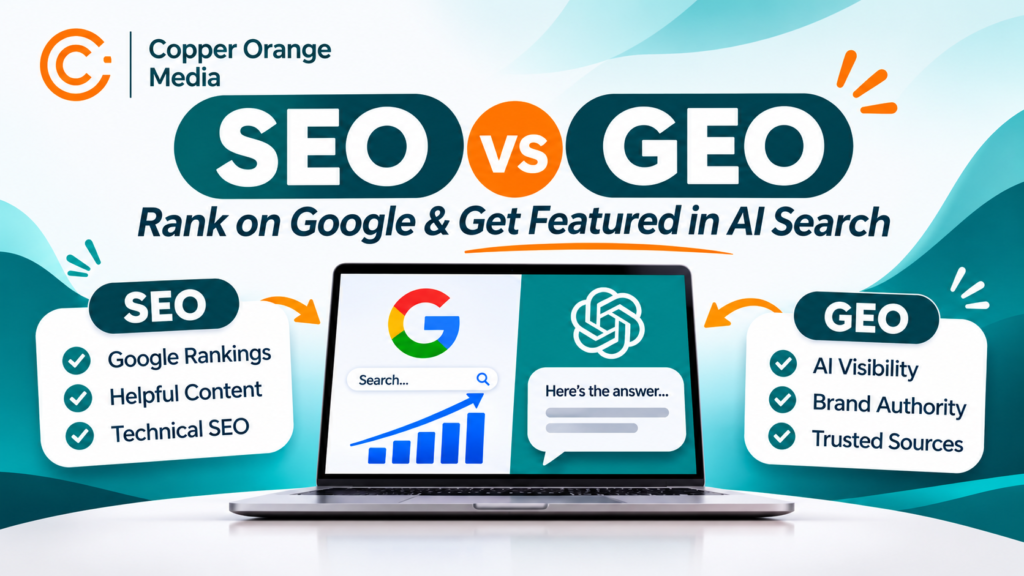
Moreover, search engines are changing how people discover businesses, products, and services. Traditionally, users searched Google, explored website links, and selected the information they needed. Today, AI-powered platforms such as ChatGPT, Perplexity, and Google AI Overviews can generate direct answers using information from multiple sources.
This shift has introduced an important question for businesses: SEO vs GEO, which strategy should you prioritize?
The answer is both. Search Engine Optimization (SEO) helps your website gain visibility in traditional search results, while Generative Engine Optimization (GEO) focuses on improving your chances of being referenced in AI-generated answers. Combining both creates stronger opportunities for online visibility and business growth.
What Is Search Engine Optimization (SEO)?
Search Engine Optimization (SEO) is the process of improving a website’s visibility in unpaid search engine results. It helps search engines understand your content and connect it with people searching for relevant information.
A successful SEO strategy includes three major areas:
- Technical SEO: Improving website speed, mobile performance, crawlability, indexing, and site structure.
- On-page SEO: Optimizing titles, headings, keywords, content, images, and internal links.
- Off-page SEO: Building website authority through relevant backlinks, digital PR, and credible brand mentions.
For example, a digital marketing agency targeting the keyword “SEO services for small businesses” can create an optimized service page that answers customer questions and explains its expertise.
The objective is to attract relevant visitors who may eventually become customers.
What Is Generative Engine Optimization (GEO)?
Additionally, Generative Engine Optimization (GEO) involves improving your content and brand’s visibility across AI-powered search experiences.
Instead of displaying only a list of links, generative AI platforms can combine information from different sources to produce conversational answers.
Examples include:
- Google AI Overviews
- ChatGPT Search
- Perplexity AI
- Microsoft Copilot
- Google Gemini
These platforms do not all select information in the same way. Their retrieval, search, and citation processes differ.
Moreover, to improve GEO opportunities, businesses should publish accurate information, demonstrate expertise, maintain clear website structures, and develop authoritative online brand presence.
For example, a company publishing original research about digital marketing trends may provide useful information that an AI-powered search platform can reference when answering related questions.
SEO vs GEO: What Is the Difference?
Although SEO and GEO share several foundations, their primary objectives differ.
| Comparison | SEO | GEO |
| Main goal | Improve search rankings | Improve AI visibility |
| Platforms | Google, Bing | ChatGPT, Perplexity, Gemini |
| Content focus | Keywords and search intent | Context, accuracy, expertise |
| Authority | Backlinks and credibility | Trusted sources and brand references |
| Visibility | Organic search listings | AI-generated answers and citations |
| Measurement | Rankings, clicks, traffic | Mentions, citations, AI referrals |
SEO focuses on helping users discover your website through search results. Similarly, GEO focuses on increasing the likelihood that AI platforms will understand, reference, or mention your business.
Neither guarantees visibility or citations.
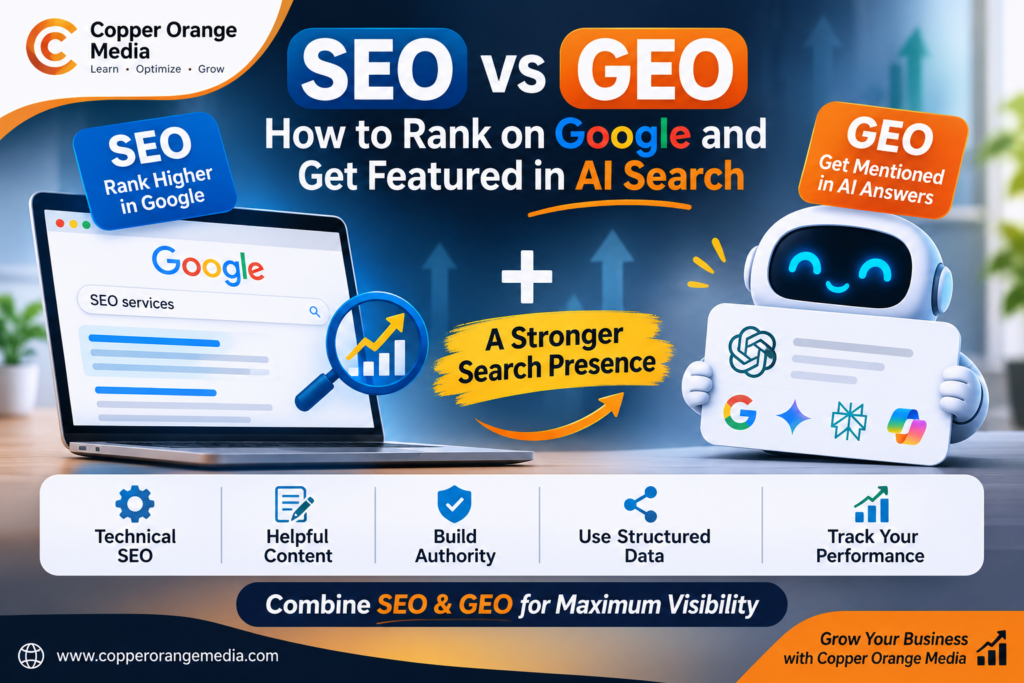
How Do SEO and GEO Work Together?
SEO provides an important foundation for AI search visibility. Furthermore, search platforms need accessible, understandable information to retrieve and evaluate relevant content.
Google also confirms that its AI search experiences use existing Search systems and that traditional SEO best practices remain relevant.
Businesses should combine both strategies by:
- Creating helpful, original website content.
- Targeting relevant keywords and customer questions.
- Improving technical SEO and website performance.
- Building topical authority through related content.
- Maintaining accurate business information.
- Earning relevant backlinks and credible brand mentions.
For example, a business offering web design services can publish an SEO-optimized guide explaining website development costs, common mistakes, and important features. The article can attract Google visitors while also providing clearly organized information that AI systems may reference.
7 Practical Ways to Optimize for Google and AI Search
1. Improve Technical SEO
Ensure your website loads quickly, works on mobile devices, and allows search engine crawlers to access important pages.
2. Create Helpful, Original Content
Publish articles that answer real customer questions. Include practical examples, expert insights, and accurate information instead of repeating generic content.
3. Target Search Intent
Understand what users want before selecting keywords. Create informative articles for research-based searches and service pages for customers ready to purchase.
4. Use Clear Headings and Direct Answers
Organize articles with descriptive H2 and H3 headings. Answer important questions directly before providing supporting explanations.
5. Build Website Authority
Earn relevant backlinks, publish expert content, and develop genuine brand mentions across credible websites.
6. Use Structured Data
Implement appropriate schema markup, such as Article, Organization, and Breadcrumb List, to provide search engines with additional information about your website.
7. Monitor Search Performance
Use Google Search Console and analytics tools to monitor impressions, rankings, clicks, organic traffic, and conversions. Also track relevant AI-generated citations and referral visits where measurable.
Remember that these practices improve discoverability and clarity, but no specific GEO technique guarantees an AI citation.
SEO vs GEO vs AEO: Understanding the Three Strategies
Another important term is Answer Engine Optimization (AEO).
- SEO: Helps websites appear in traditional search results.
- GEO: Focuses on visibility and references in generative AI responses.
- AEO: Focuses on making information easy to identify and deliver as a direct answer.
These approaches overlap. A well-structured, informative website can support all three.
Common SEO and GEO Mistakes to Avoid
Businesses should avoid several common mistakes:
- Publishing generic AI-generated articles without adding value.
- Stuffing keywords unnaturally into website content.
- Ignoring technical SEO problems.
- Using unsupported statistics or misleading claims.
- Buying low-quality backlinks.
- Adding unnecessary schema markup.
- Assuming that an llms.txt file guarantees AI visibility.
Focus on useful content, website accessibility, and genuine authority rather than chasing optimization shortcuts.
Conclusion
The discussion around SEO vs GEO is not about choosing one strategy over another. Businesses need a balanced approach that supports traditional search rankings while improving their visibility across emerging AI-powered platforms.
Furthermore, from technical SEO and keyword research to original content and brand authority, every improvement contributes to a stronger digital presence.
At Copper Orange Media, we help businesses strengthen their online visibility through strategic SEO, content optimization, and data-driven digital marketing.
Ready to improve your search performance? Explore our Search
Frequently Asked Questions
1. What is the main difference between SEO and GEO?
SEO improves visibility in traditional search results, while GEO focuses on increasing visibility in AI-generated answers and recommendations.
2. Is GEO replacing traditional SEO?
No. SEO remains important because search engines and AI-powered search experiences still rely on discoverable, relevant, and useful online information.
3. How can I appear in Google AI Overviews?
Create helpful content, follow technical SEO best practices, answer relevant questions, and demonstrate expertise. Inclusion is determined by Google’s systems and cannot be guaranteed.
4. How do I get my website cited by ChatGPT?
Make your content accessible to OpenAI’s search crawler, publish accurate and useful information, and build a credible online presence. Citation selection is not guaranteed.
5. Does schema markup help with GEO?
Structured data helps search engines interpret website information. However, schema markup does not guarantee AI citations or improved rankings.
6. How long does GEO optimization take?
There is no fixed timeline. Results depend on content quality, website accessibility, authority, competition, and how individual AI platforms retrieve information.
7. Should small businesses invest in SEO and GEO?
Yes. Combining strong SEO foundations with useful, authoritative content can help small businesses improve discoverability across traditional and AI-powered search experiences.
8. How can businesses measure AI search visibility?
Monitor brand mentions, source citations, AI referral traffic, and visibility across a consistent set of relevant customer questions.